 mekong
Test the source
Identify the intended water use and actual contaminants. Assess seasonal changes, demand, access, power and the available operator.

STAGE 07 / PROTECT · DELIVERABLES #13 & #14
Community treatment that can be maintained locally. Membrane capability that grows from tested ideas into a reliable local supply.
Explore the 2027–2029 work plan ↓Cut open the treatment unit and follow the water through five barriers.
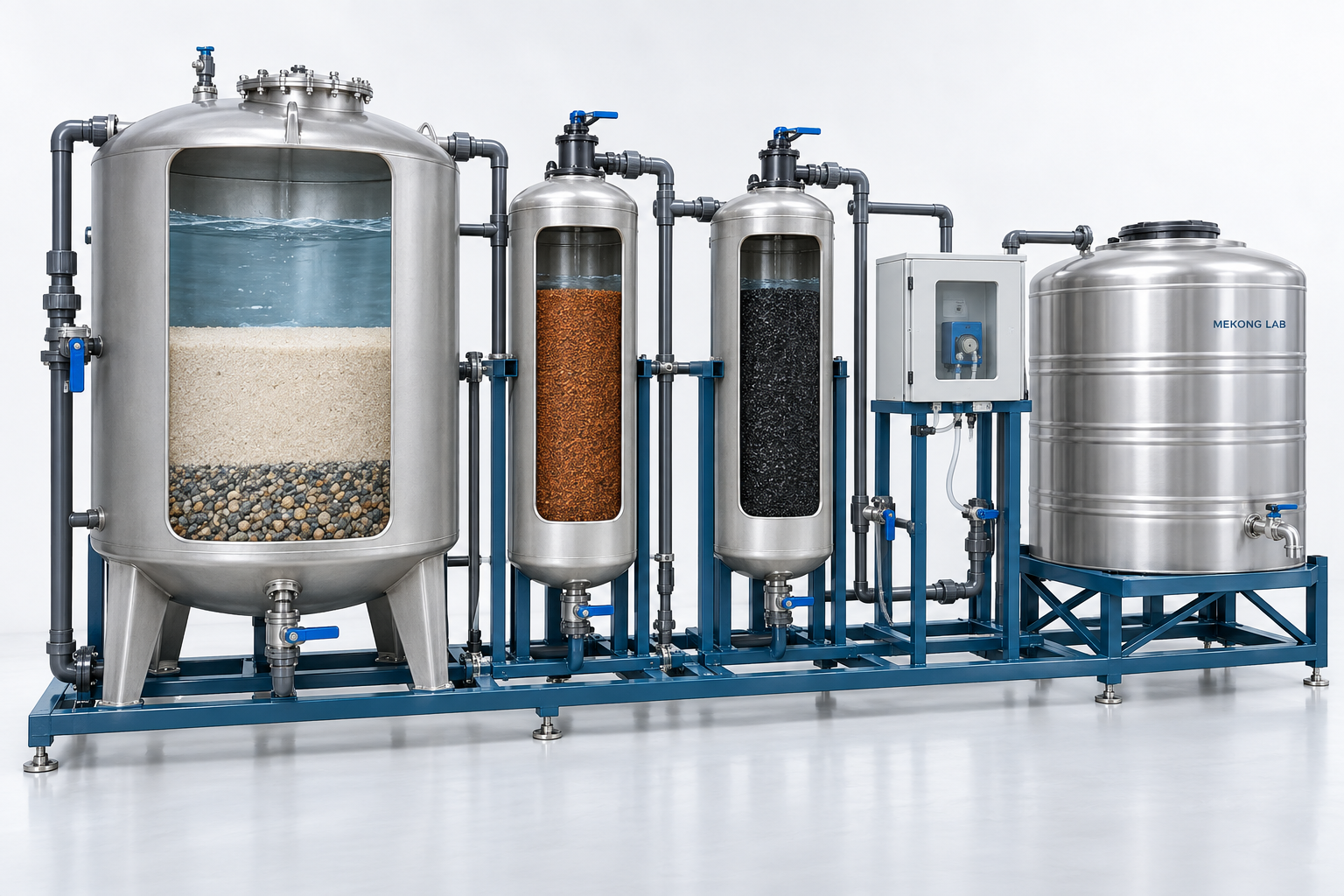 13 / CUTAWAY VIEW
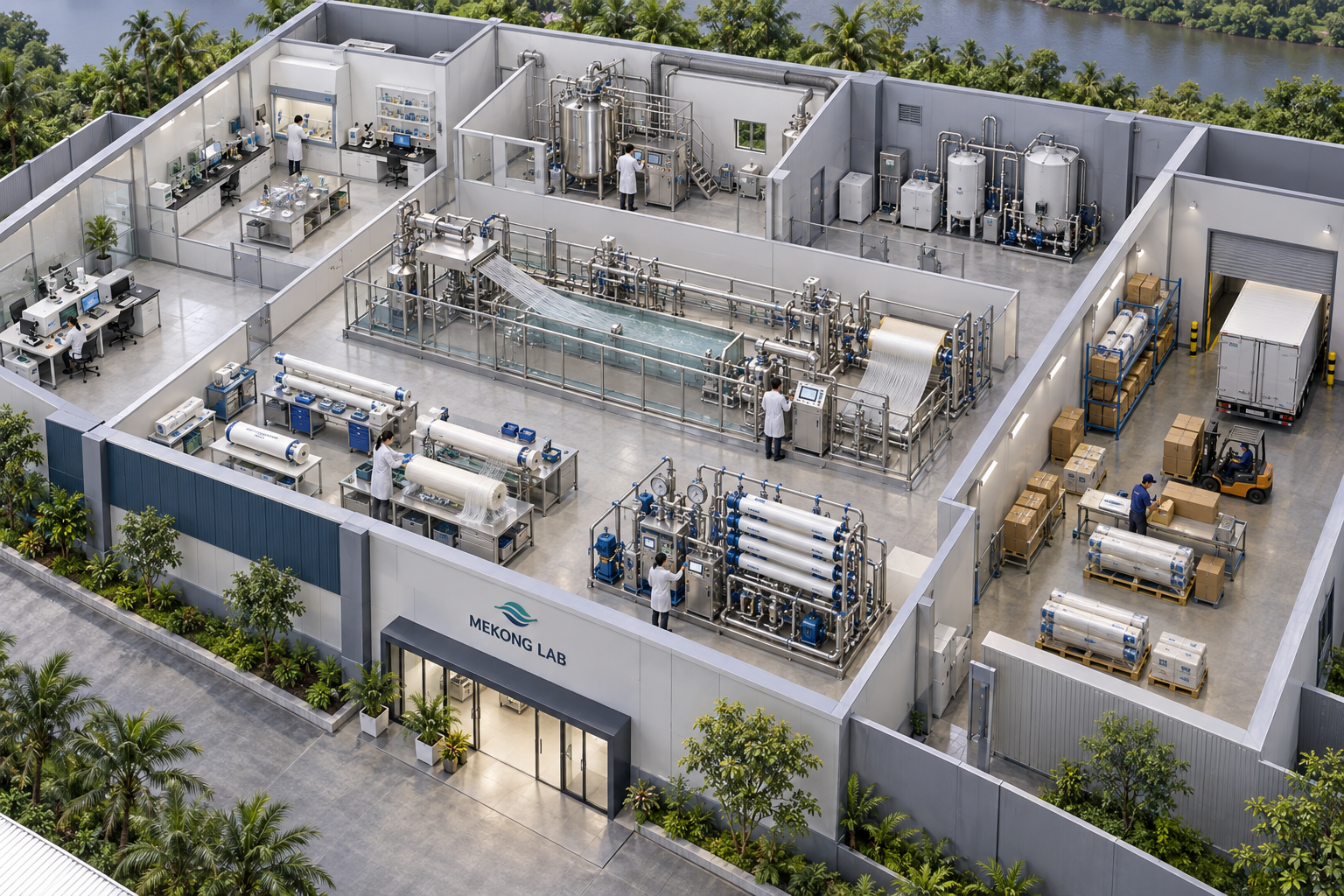 14 / CUTAWAY VIEW
FOLLOW THE WATER
DELIVERABLE #13 / FROM KIT TO COMMUNITY SERVICE
A modular approach uses serviceable tanks, replaceable media and standard fittings. Local workshops assemble the system to an engineered design; trained operators maintain it with a laboratory behind them.
Identify the intended water use and actual contaminants. Assess seasonal changes, demand, access, power and the available operator.
Specify suitable vessels, qualified sand and adsorptive media, valves, disinfection, protected storage and sample ports. Use a supervised local assembly team.
Compare raw and treated water, verify flow and treatment performance, and train the operator before releasing the service for its intended use.
Plan media replacement, consumables, maintenance and residuals disposal. Share test results and service status with the community.
DELIVERABLE #14 / A LOCAL MEMBRANE SUPPLY CHAIN
Develop a membrane centre with a laboratory, pilot fibre manufacturing, module assembly, quality testing and distribution. Connect community field performance back to the production team.
Define the source-water challenge, test reference membranes and establish technical capability in a host laboratory.
Evidence: accepted testing methodDevelop controlled fibre production and assembly trials. Secure technical rights, training, utilities and process-waste management.
Evidence: traceable trial modulesValidate the product, operating cost, demand and service network before committing to commercial manufacturing scale.
Evidence: a viable production decisionThe centre illustration is a target facility concept. Ultrafiltration does not remove dissolved chemicals such as arsenic; treatment selection may require additional adsorption or an appropriate NF/RO process. Treatment capabilities · CDC ↗
ONE FRAMEWORK / COLLECTIVE DELIVERY
Bring research, industry, development partners and community operators together under the Lao National Water Quality Innovation Strategy. Build on existing support and share test facilities, evidence and training.
Lead source assessments, choose pilot communities, host the laboratory, assemble and maintain systems, and publish verified results in the national data hub.
Local ownership · shared resultsExplore collaboration on treatment media, material testing and locally serviceable filtration prototypes, drawing on NANOTEC's documented community water-purification research.
NANOTEC water research ↗Explore technical exchange, pilot evaluation, operator training and connections to the membrane research and industry ecosystem. Develop manufacturing and licensing arrangements with qualified technology partners.
PUB research & development ↗Partner roles are invitations for discussion; no signed partnership, funding or technology transfer is represented. PUB is a prospective knowledge and testing partner, not an assumed membrane manufacturer.
RESULT-BASED / TANGIBLE / DEPLOYMENT-DRIVEN
Start with working pilots, expand on evidence and build local ownership. These are programme target milestones, linked to the shared national roadmap.
Commission the first treatment demonstration where need is verified, with baseline results and a trained operator.
Complete the agreed expansion of justified treatment demonstrations, record before-and-after results and establish local operating arrangements.
Complete an independent evaluation of sustained treatment outcomes, publish the demonstration findings and accept handover of the agreed systems with trained operators and funded maintenance.
Trained local operators sustain the accepted systems with supplies, maintenance and continuing water-quality verification.
Activate an initial membrane test bench and training service at a confirmed host facility.
Commission the centre for membrane testing, operator training and assembly trials with technical partners.
Complete assembly trials and product-quality assessment, validate the centre’s testing and assembly capability, and issue a documented decision on feasible local production with an accepted operating plan.
The centre continues testing, training and accepted assembly services; any further production expansion follows the documented feasibility decision.