 mekong
1 year 3 deliverables
Complete the strategy and core digital releases in 2027.
THE THREE-YEAR DELIVERY VIEW
14 deliverables · 28 distinct milestones · January 2027–December 2029
Select a diamond to explore its target. A deliverable ends at its completion milestone; later years stay empty. All dates are proposed. Scroll sideways on smaller screens.
Proposed delivery periods reflect the work required to accept each output. Later milestones are retained only for a distinct expansion, validation or handover phase. Exact scope, operators and delivery capacity are confirmed during mobilisation.
Complete the strategy and core digital releases in 2027.
Deploy in 2027; finish integration, coverage or capability in 2028.
Deploy early; complete additional validation and development by 2029.
Open a deliverable to see the reasoning for its duration and who sustains it after acceptance. Completion is a future target, subject to evidence and acceptance.
WHAT WE PUT IN PLACE
Identify priority contaminants, vulnerable communities, strategic water sources and capability gaps. Stocktake all development partners’ bilateral water-quality support and harmonize projects, agencies and investments under one National Water Quality Innovation Strategy to reduce fragmentation and redundant support.
Stocktake all development partners’ existing and planned bilateral water-quality support so that agencies, projects and investments align under one National Water Quality Innovation Strategy. Harmonize support, fill gaps and reduce fragmented projects and redundant development investment.
Strategy accepted with the partner-support stocktake, shared priorities, responsibilities and deployment plan.

National priorities, a development partner support stocktake, shared delivery responsibilities and a results-based deployment roadmap. Align bilateral support under the same framework to fill gaps, reduce redundancy and achieve measurable outcomes.
Why this duration The strategy is a bounded deliverable: a support stocktake, agreed priorities, responsibilities and an endorsed deployment framework. It can be accepted within the first year.
Approve the National Water Quality Innovation Strategy with the bilateral-support stocktake, agreed priorities, partner contributions, agency responsibilities and a shared results-based deployment plan.
The Lao-led programme team maintains the partner register, harmonizes new support and reviews results quarterly through 2029 and beyond.
A Lao-led coordination mechanism, a maintained partner-support register and one shared deployment framework linking all partner contributions to tangible results.
THE STRATEGY THAT CONNECTS ALL SEVEN STAGES
Explore the starting gaps, coordinated support, year-by-year delivery method and shared results review.
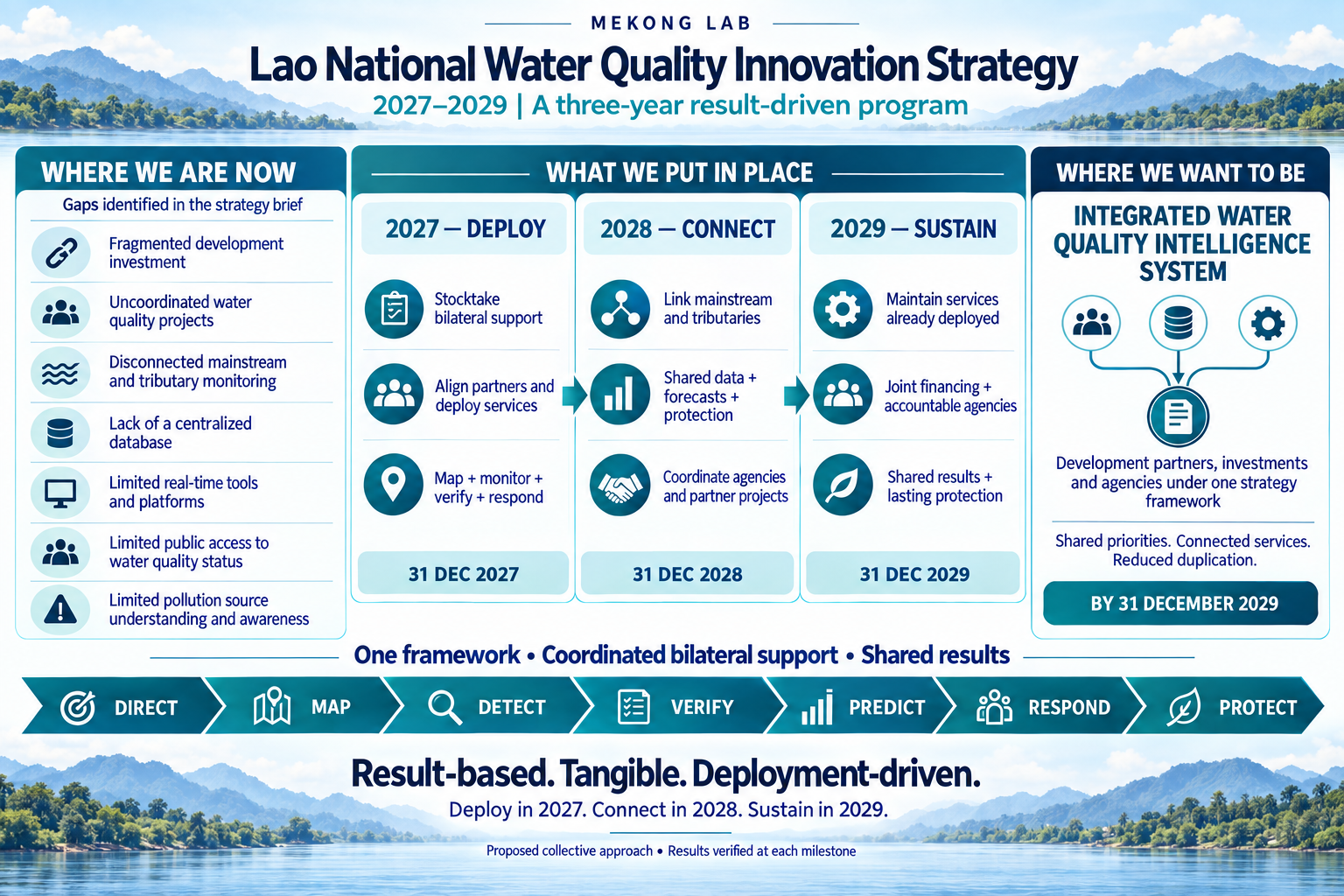
Integrated means development partners, bilateral support, investments and agencies come together under the National Water Quality Innovation Strategy to reduce fragmented projects and redundant support.
The strategy is accepted once in 2027. These steps cover its preparation and continuing programme coordination through 2029.
Compile existing and planned bilateral water-quality support from all identified development partners. Record projects, agencies, locations, assets, data, schedules and commitments; track missing information explicitly.
Tangible outputA first consolidated partner-support register showing overlapping activity, complementary capacity and unmet needs.
Map every contribution to the 14 deliverables and priority catchments. Agree lead and supporting roles, identify where projects can be combined or refocused, and check new proposals against existing support.
Tangible outputA shared responsibility and contribution matrix, with dated actions to close gaps and reduce redundant support.
Use common locations, parameters, sampling methods, data identifiers and access arrangements. Coordinate mainstream and tributary monitoring and connect partner datasets through the national data hub.
Tangible outputA common monitoring and data protocol that enables agencies and partner projects to work as one intelligence service.
Run short quarterly delivery reviews from 2027 with agencies and partner focal points. Review working services, resolve overlaps, redirect agreed support to remaining gaps and publish understandable water-quality and programme updates.
Tangible outputA shared results register, coordinated corrective actions and approved public reporting across the integrated programme.
Align partner financing commitments and agency operations around staff, consumables, maintenance, training and service continuity. Maintain the joint programme after individual projects end.
Tangible outputAn Integrated Water Quality Intelligence System sustained by accountable agencies, coordinated partners and maintained services.
Put the map to work, activate field teams and deliver the first evidence-to-action services.
Tangible resultBy 31 December 2027: a working map, active monitoring, laboratory evidence, first response services, a forecasting prototype and the first treatment demonstration.
Acceptance evidenceRelease records, sampling and laboratory logs, a completed response exercise and treatment commissioning evidence.Complete #1, #10 and #11 in 2027. Deploy initial phases of #2–9 and #12–14; their remaining milestones deliver new capability or validation.
Connect partner projects, agencies and technical services under the shared framework; expand services with demonstrated results.
Tangible resultBy 31 December 2028: the full intelligence-to-action chain is connected, forecasting is in validated use and the technology centre is operating.
Acceptance evidenceIntegrated service demonstration, forecast validation, expanded site acceptance and centre commissioning records.Complete #2–8 and #12 by their 2028 deadlines. Keep accepted 2027 deliverables in use. Continue distinct development phases for #9, #13 and #14.
Sustain services deployed from 2027 through aligned partners, accountable agencies, coordinated financing and routine joint review.
Tangible resultBy 31 December 2029: an Integrated Water Quality Intelligence System with coordinated development partners and investments, accountable agencies, connected services and sustained community protection.
Acceptance evidenceJoint results review, documented reduction of overlapping support, accountable service owners and aligned continuation commitments.Complete #9 by 30 September 2029 and #13–14 by 31 December 2029. Sustain all accepted outputs under one framework without repeating their completion milestones.
Use January 2027 to confirm the baseline, delivery owners and initial sites. Keep consultation focused on decisions that enable delivery.
Run essential permissions and community engagement alongside configuration, procurement, training and field mobilisation. Reuse suitable assets to move faster.
Review functioning services, field records and community outcomes every quarter. Release the next deployment increment against accepted evidence.
Confirm the initial sites in January 2027. These proposed settings guide selection; the final locations and coverage remain to be agreed.
Connect source records, monitoring, verified evidence and downstream users in one practical deployment.
Put wastewater records, laboratory evidence and accountable agency response into use on a manageable reach.
Demonstrate source assessment, suitable treatment and trained local operation where a verified need exists.
A mapped signal becomes a tracked sample, a reviewed result, a downstream assessment and an assigned response.
Commission suitable treatment, compare water-quality results and demonstrate trained local operation.
Show accountable staff, quality records, service continuity, supplies and funded maintenance for every deployed service.
These temporary review ticks explore the proposed acceptance criteria; they do not certify real deployment.
Dates and outcomes are proposed programme targets. These references inform technical practice and do not endorse the delivery schedule.
Supports risk assessment from catchment to consumer and verification of improvements.
A Lao-language resource for drinking-water providers, training and adaptation.
Describes the regional monitoring framework, designated laboratories and the role of data in prevention and response.
Illustrates practical community water services, local management and climate resilience.
Build a shared picture of potential pollution sources, discharge locations, river connections and communities that could be affected.
Put a usable shared map in the hands of teams within the first 90 days. Add coverage and better records through regular releases.
First operational map and data hub for the initial sites.
Connected, accessible records supporting the entire process.
Why this duration A usable hub launches in 2027. A second delivery phase integrates the field, laboratory and response services as they become available.
Launch the searchable data hub with location, source, monitoring and partner-project records for initial sites.
Accept the integrated hub across the agreed network: connect field, laboratory and response records, provide forecasting interfaces, and test access controls, backups and operator handover.
The data custodian maintains records, backups and access controls. New validated forecasting feeds use the interfaces delivered by the hub.
Mapped mines, factories, agricultural pressures and wastewater outlets.
Why this duration The first map can use existing records. A second phase verifies sources, fills coverage gaps and links permits and reviewed evidence across the agreed deployment areas.
Release a working map of priority pollution sources, river connections and downstream water users.
Complete the agreed map coverage, verify priority source locations, link permit and monitoring records, and hand over an auditable update procedure to named record owners.
Designated record owners update pollution sources, permits and river connections through the established data service.
A maintained source-to-river-to-community map and data hub supporting the agreed network.
Real Mekong geography with fictional mining, agriculture, factory and community source records.
Open the Mekong pollution source map ↗Combine observations from space, river monitoring and community testing to identify changes that need investigation. These complementary approaches flag potential problems for verification.
Start collecting usable observations in 2027. Combine field measurements and community reports with satellite screening to direct investigations.
Routine sampling, community reporting and satellite screening operating at initial sites.
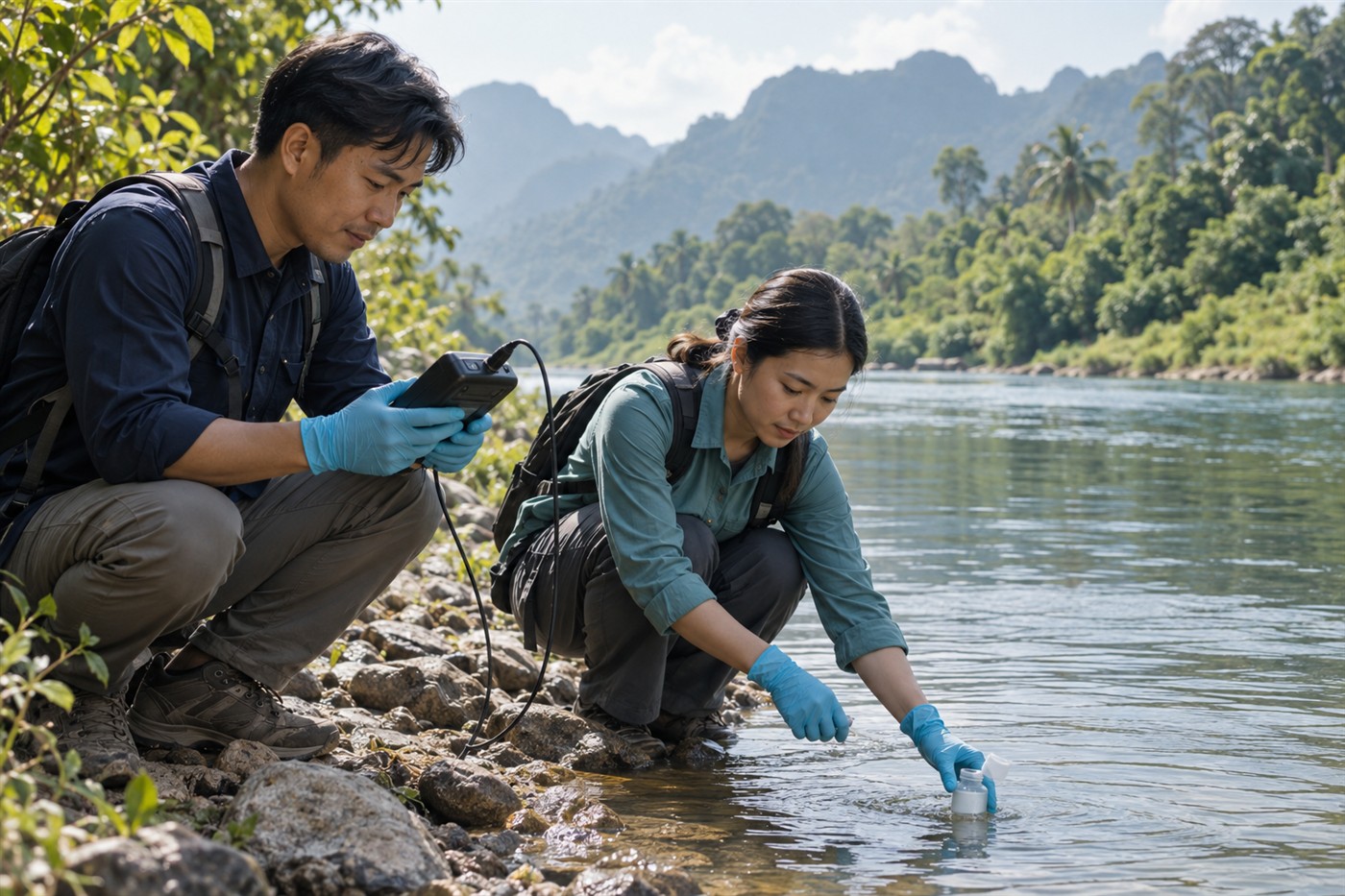
Why this duration Screening can start in year one. Field comparison and quality acceptance require a distinct validation phase before the agreed service is handed over.
Deploy satellite and AI screening for initial sites and send investigation flags to field teams.
Benchmark screening against field evidence, document usable conditions and error limits, connect investigation cases, and accept the service for the agreed coverage.
The analysis team runs surveillance, reviews screening performance and maintains the accepted models and investigation workflow.
Why this duration Initial communities begin testing in 2027. Extending the network requires another phase of recruitment, training, quality checks and local support arrangements.
Train the first community teams, issue suitable test kits and activate a reporting-to-verification route.
Complete rollout to the agreed communities, demonstrate testing and reporting quality, and hand over coordination, resupply and response-feedback arrangements.
Local coordinators provide refresher training, replacement supplies and feedback on reports as routine network operations.
Why this duration The first coordinated sampling routes launch in 2027. The full agreed network needs a second phase of route expansion, seasonal coverage review and data-quality acceptance.
Activate coordinated mainstream–tributary sampling routes across agency and partner projects, with schedules and traceable records.
Complete the agreed monitoring network, review wet- and dry-season coverage, connect quality-checked records to the hub, and accept field procedures and support arrangements.
Agency and partner field teams continue routine sampling, equipment maintenance and quality review under the common monitoring plan.
A functioning detection network with trained teams, recorded observations and an investigation workflow.
Real Sentinel-2 imagery alongside community testing and river-station demonstrations.
Open satellite & water monitoring ↗Investigate flagged locations, collect samples and establish the type, concentration and extent of contamination. Check suspected activities against permit records.
Deploy sampling logistics, capable staff and validated methods together so that early signals can lead to defensible decisions.
First sample-to-result service running with laboratory and mobile field teams.

People, equipment and procedures to confirm what is happening.
Why this duration Existing laboratories can deliver priority tests in 2027. Targeted upgrades, additional validated methods and proficiency checks form a separate second-year acceptance phase.
Deliver the first reviewed priority-parameter results using trained analysts, validated methods and sample custody.
Complete the agreed laboratory upgrades and analytical methods, demonstrate proficiency and sample turnaround, connect reviewed results to the hub, and accept the supported service.
Laboratory operators maintain quality assurance, supplies, equipment and staff competency within the accepted analytical scope.
Mobile laboratory trucks extend field investigation and testing outreach to communities.
Why this duration A first mobile service launches in 2027. Procurement, commissioning and staffing of the remaining agreed fleet units require a second deployment phase.
Commission the first mobile laboratory truck service with trained staff, sampling equipment and transport procedures.
Commission all remaining agreed fleet units, demonstrate outreach routes and laboratory connections, and accept staff rosters, equipment servicing and resupply arrangements.
Field coordinators operate outreach routes, service vehicles and instruments, and maintain laboratory links and supplies.
An operating laboratory network and mobile field fleet with maintained equipment, supplies and trained analysts.
Interactive equipment concepts and a practical deployment work plan for deliverables #7 and #8.
Open laboratories & mobile lab deployment ↗Use verified observations and river-flow information to estimate where pollution could travel, when it might arrive and which water intakes or communities could be exposed.
Build forecasting early, test it alongside field delivery and bring it into reviewed operational use during 2028.
First forecasting prototype running in shadow mode on a selected river reach.

Connect the data hub, monitoring network and AI capability to deliver downstream forecasts and exposure scenarios.
Why this duration A prototype, independent validation on the initial reach, and validation of additional agreed reaches are three different outputs. Expansion must demonstrate performance for its intended use.
Run a forecasting prototype in shadow mode on a selected reach using verified observations and river flow.
Complete independent validation for defined uses on the initial reach and introduce human-reviewed operational forecasts.
Validate the additional agreed river reaches and exposure scenarios, demonstrate downstream intake and response integration, and accept the forecasting service with documented uncertainty and use limits.
The modelling team monitors performance, refreshes inputs and supports human-reviewed forecasts within the accepted limits.
A validated forecasting service operating within documented limits and supporting downstream decisions.
Explore a mining release, confluence mixing and downstream exposure pathways.
Open the pollution simulation ↗Deliver targeted alerts, assign responsible agencies, investigate discharges and track corrective action. Give communities timely, understandable information.
Deploy the action workflow alongside monitoring. Every reviewed incident should reach a responsible team and be tracked to closure.
Dashboard, app and case tracking in use by the first response teams.

Why this duration The dashboard and warning workflow are a bounded software release that can be accepted in 2027. Later data connections belong to hub and forecasting integration, avoiding duplicate platform delivery.
Accept the dashboard and early-warning platform after the June launch: demonstrate mapped evidence, approved public status, authorized alert review, acknowledgement and case tracking, with tested continuity and named support.
The response team operates the platform, maintains continuity and connects additional accepted feeds through the common interfaces.
Why this duration The agreed app release can be built, tested and handed over in one year. Routine updates and onboarding through community deployment do not require repeating the app deliverable.
Accept the Lao Water Intelligence App for the agreed users: demonstrate water-quality information, field reporting, accessible messages and consented notifications, complete user testing and hand over support.
The support team maintains the app, assists users and releases routine updates; community onboarding follows the network deployment plan.
Why this duration Initial case handling starts in 2027. Connecting permit, inspection and laboratory records and demonstrating cross-agency closure requires a second delivery phase.
Put initial permit and discharge records, incident assignment and corrective-action cases into use.
Complete the agreed compliance workflow by linking inspections, laboratory evidence and closure records; demonstrate cross-agency handovers and accept named case ownership and audit procedures.
Responsible agencies operate inspections, case assignment and corrective-action follow-up through the accepted compliance service.
An operating dashboard, Lao Water Intelligence App and compliance-response service with accountable handovers.
Map pollution signals, preview mobile notifications and rehearse an outlet response.
Open the response workspace ↗Where water-source assessments demonstrate a treatment need, develop suitable community systems and the local capability to operate, maintain and supply them. Verify that interventions improve water quality.
Deliver early community benefits using suitable treatment and trained operators. Develop local technical capability while systems are running.
First treatment demonstration operating where assessment confirms a need.
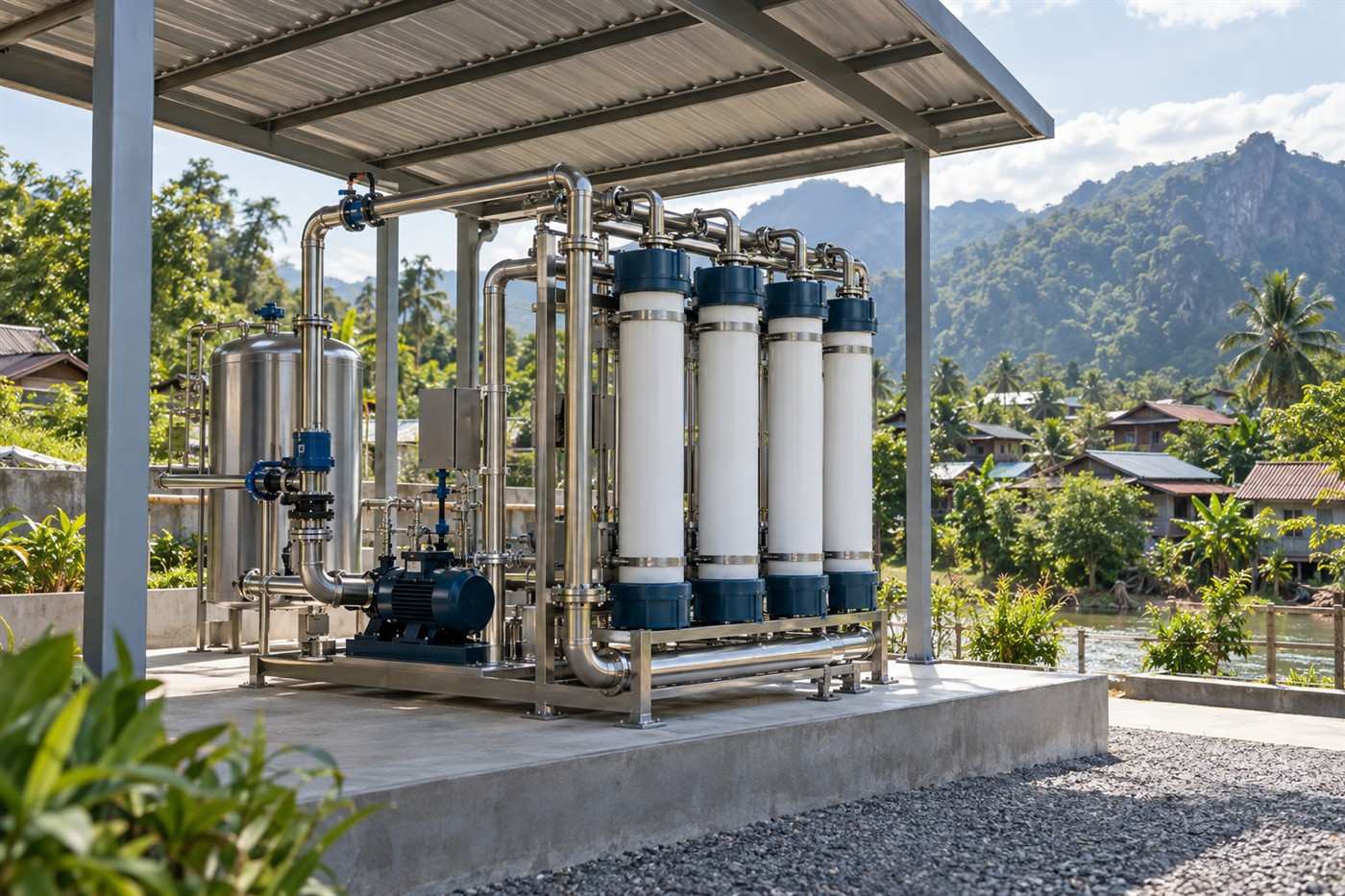
Why this duration A first treatment demonstration, evidence-based expansion and an independent assessment of sustained water-quality outcomes require successive field and evaluation phases.
Commission the first treatment demonstration where need is verified, with baseline results and a trained operator.
Complete the agreed expansion of justified treatment demonstrations, record before-and-after results and establish local operating arrangements.
Complete an independent evaluation of sustained treatment outcomes, publish the demonstration findings and accept handover of the agreed systems with trained operators and funded maintenance.
Trained local operators sustain the accepted systems with supplies, maintenance and continuing water-quality verification.
Progress through testing, assembly and feasible production stages.
Why this duration The test bench, commissioned centre and validated assembly and production-feasibility decision are distinct development outputs. Production advances only where testing supports it.
Activate an initial membrane test bench and training service at a confirmed host facility.
Commission the centre for membrane testing, operator training and assembly trials with technical partners.
Complete assembly trials and product-quality assessment, validate the centre’s testing and assembly capability, and issue a documented decision on feasible local production with an accepted operating plan.
The centre continues testing, training and accepted assembly services; any further production expansion follows the documented feasibility decision.
Operating community treatment services and an active technology centre for testing, training and feasible local assembly.
Interactive cutaways, treatment media, facility equipment and the delivery work plan.
Open the community protection workspace ↗Proposed delivery targets. Each achievement requires acceptance evidence. Treatment follows verified need; local production follows demonstrated feasibility. The forecasting engine (#9) remains a proposed deliverable.